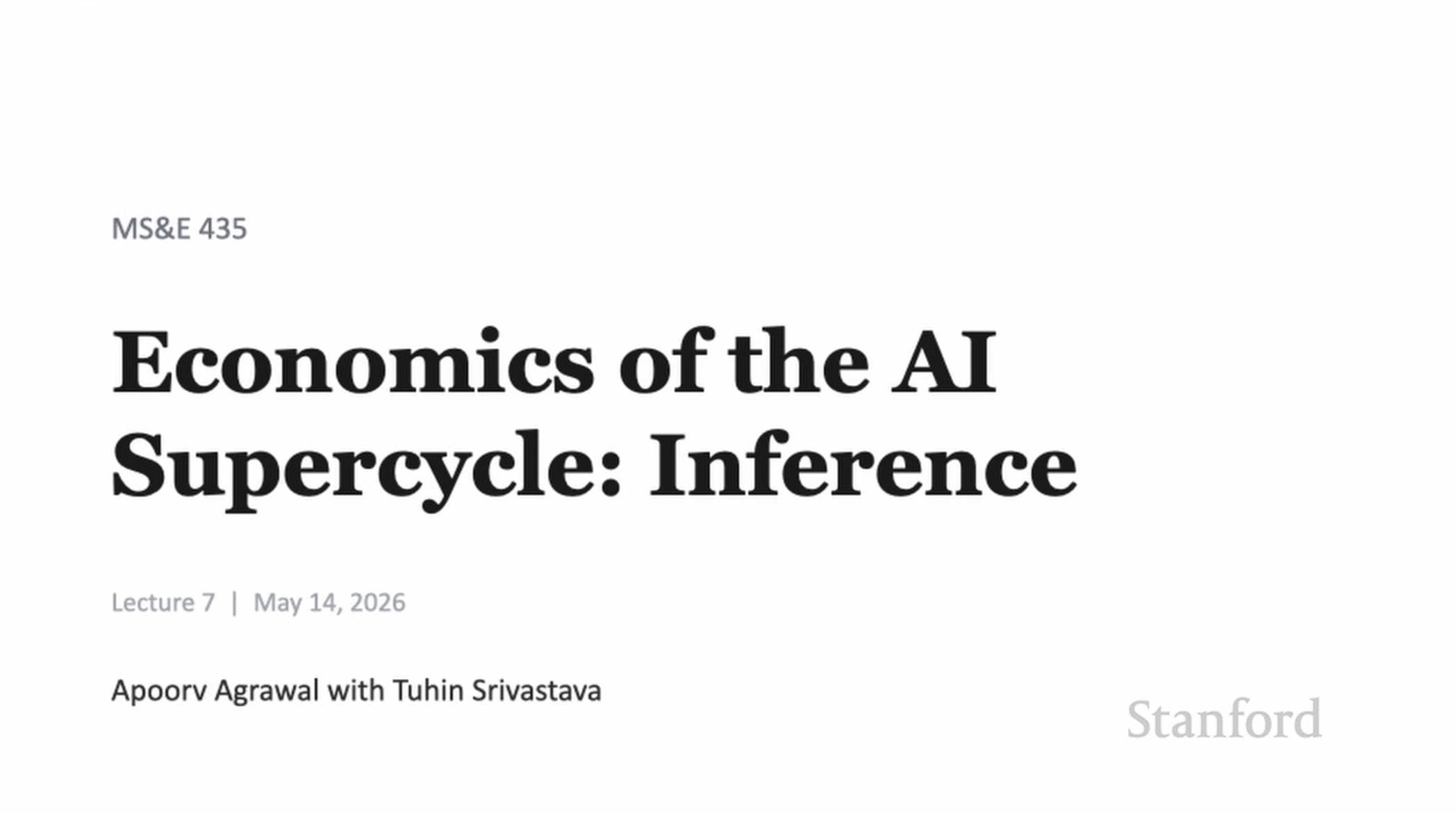
🎙 We held the seventh Lecture Club call on Stanford MS&E 435: Economics of the AI Supercycle.
Lecture 7 — Tuhin Srivastava (Baseten). The topic was the economics of inference: open-weight vs. open source, renting GPUs vs. owning, heterogeneous compute. The group agreed that the value of the lecture was not in the guest's pitch but in the macro picture — and quickly shifted the discussion there.
Some thoughts from the discussion:
• Nikita (me, led the call) — clarified terminology: open-weight ≠ open source (pre-trained weights are available, but how they were trained is not). The main unasked question: whatever you fine-tune on secret data, the next frontier generation will outdo your model with generalization, and open weights are already lagging by ~3 months. The advantage of open weights is self-hosting: cheaper and more secure for corporations that fear giving data to OpenAI/Anthropic.
• Stepan (ML product, GigaChat) — the lecture was "passable": the points about 3 months and "inference 90% cheaper" are shaky, the frontier sells the API wrapper, not just the model. The real recipe is not one-time fine-tuning but a constant pipeline "data → evals → new pretrain" (that's how Alisa AI and Cursor grew). He doesn't believe in the disappearance of open source; he won't go to work in the USA — frontier labs and Palantir work with the Pentagon.
• Jean (futurist) — the lecture was about industry problems, not the guest's pitch: "open source" is about emission, not money; big players can break the rules and distill others' models, small ones cannot. The main issue is two monopolists and the state, which can ban a model "for national security" overnight. In Russia, infrastructure is lacking: you can't set up a rack in a data center, can't buy hardware.
• Mars (Power of Silicon) — saw a business opportunity: clouds are already renting AI clusters as a service (Turbo Cloud by Rostelecom), and the next layer is helping clients run models in a closed environment. There will be demand: corporations don't want to give data to public models.
• Anna (enterprise, Germany) — the guest's idea about energy and modular data centers rhymes with modular nuclear power plants: bringing power closer to the client for streaming tasks. In enterprise — a major restructuring and currently no clear strategy.
• Pavel (Telegram bots, agents) — "3 months" is based on benchmarks, far from reality. Chinese open weights are a way to capture the market and collect data, monetized by subscription (GLM raised prices, new models are first tested internally). Advice: reread AI 2027 — more and more is coming true.
• Dmitry — on Apple: three years of "corporate games" around AI strategy, changed the director of the direction — Apple still has a move due to control over hardware.
• Nikita (closing) — a separate trend: free models for advertising (Anthropic already has ad cabinets, Google has integration in Chrome/mail/search). And Chamath's thesis: unlike SaaS, in AI, each new user exponentially increases costs — there is no more zero marginal cost.
📺 Recording of the call:
https://youtu.be/SQguPHH0UmE