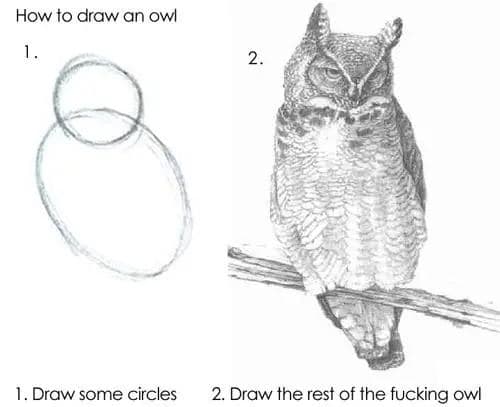
Today was the second day of the MIT Deep Learning course 6.S191. While the first day covered familiar concepts in a systematic way, the second day delved into hardcore topics. I’m reminded of the meme about drawing an owl.
In addition to interesting thoughts on CNNs, VAEs, GANs, CycleGANs, and their applications in self-driving cars, classifications, cancer detection, and generative tasks, we again touched on the issue of ethics. For example, if you train your network on images from the internet where 90% of the people are white, you shouldn’t be surprised that it doesn’t perform as expected on other skin colors. And while skin color and gender are somewhat understandable and can be tracked during the training phase, what do you do with features that aren’t obvious at first glance? Another example is if a self-driving car is trained on standard situations, what will it do if a police helicopter, which it has never seen before, starts to land in front of it?
The first question leads to the second. Where is the application of artificial intelligence justified and safe, and where is the cost of error too high? Making a mistake in generating an image and drawing six fingers is not the same as predicting a medication for a patient that could lead to their death. It seems that when developing models, it’s important to understand where you are on this scale and how you should approach training/testing/control. There seems to be a separate course on ethics in AI.
Besides the lectures, the lab work is really cool. For example, in the first lab assignment, you need to write a neural network that generates new music in the same style based on previous music.
If anyone is interested in trying it out - the Jupyter notebook is available here https://github.com/mertbozkir/Music_Generation_RNNs/blob/main/Part2_Music_Generation.ipynb
Slides
Lecture 3 http://introtodeeplearning.com/slides/6S191_MIT_DeepLearning_L3.pdf
Lecture 4 http://introtodeeplearning.com/slides/6S191_MIT_DeepLearning_L4.pdf