"Computers are everywhere except in productivity statistics"
This phrase was written by Robert Solow, a Nobel laureate in economics, in 1987. Computers were already in every office, yet productivity growth in the US was not accelerating. It even slowed down compared to the 50s and 60s.
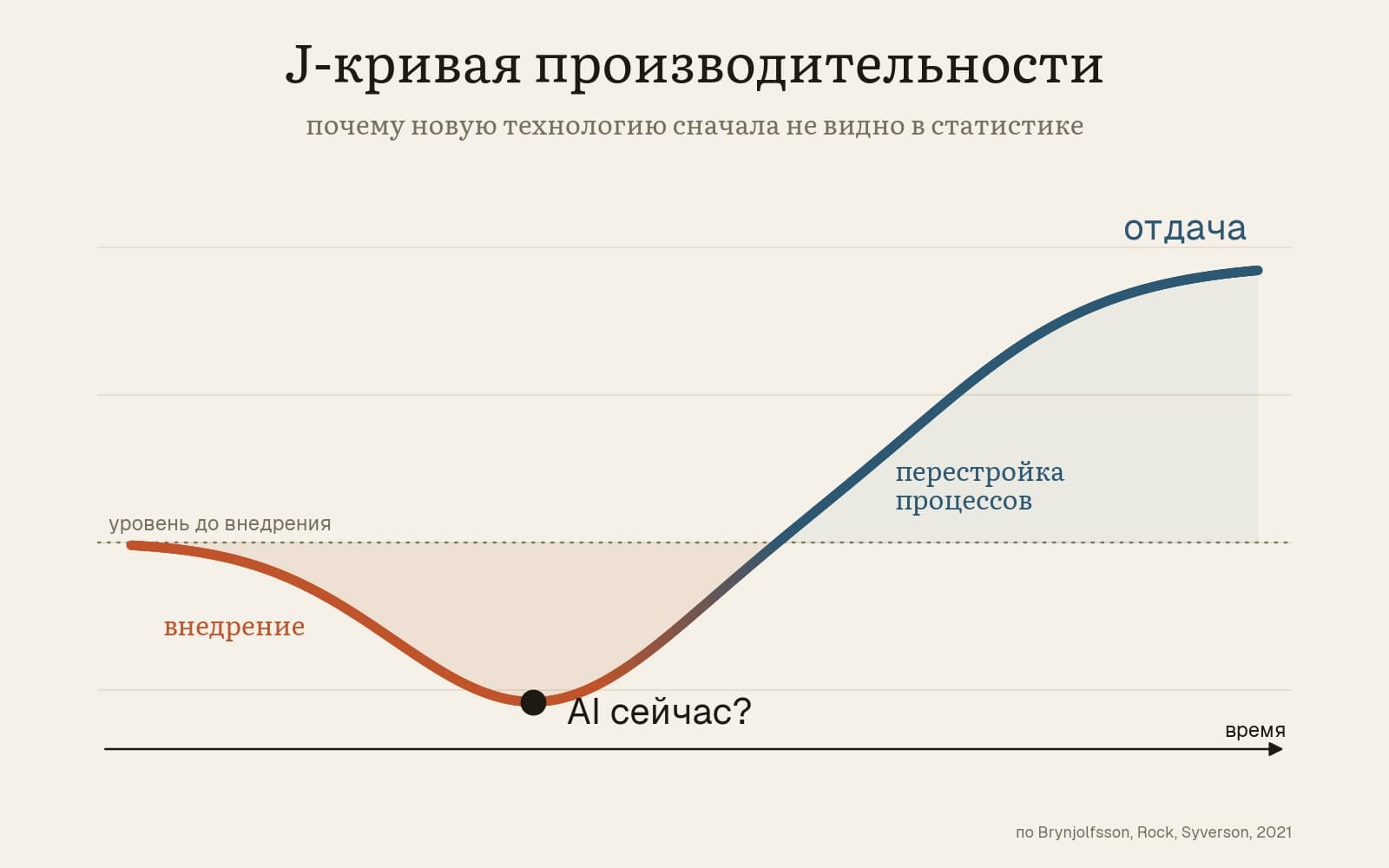
I often think about how, despite AI being talked about everywhere, it is still not visible in GDP graphs. Perhaps this is again due to Solow's productivity paradox.
Economic historian Paul David found a similar case with electricity in 1990. The electric motor appeared in the 1880s, but factory productivity only noticeably increased in the 1920s. For forty years, factories simply replaced steam engines with electric motors and kept the old layout: one shaft for the entire workshop, belts, multi-story buildings. Returns appeared when factories were rebuilt around the new technology: a motor for each machine, single-story workshops, and a process-oriented line.
With computers, it turned out the same: productivity growth in the US came in 1995-2004 when companies restructured their processes around them.
#ai@rvnikita_blog #economics@rvnikita_blog #productivity@rvnikita_blog #robert_solow@rvnikita_blog #paul_david@rvnikita_blog