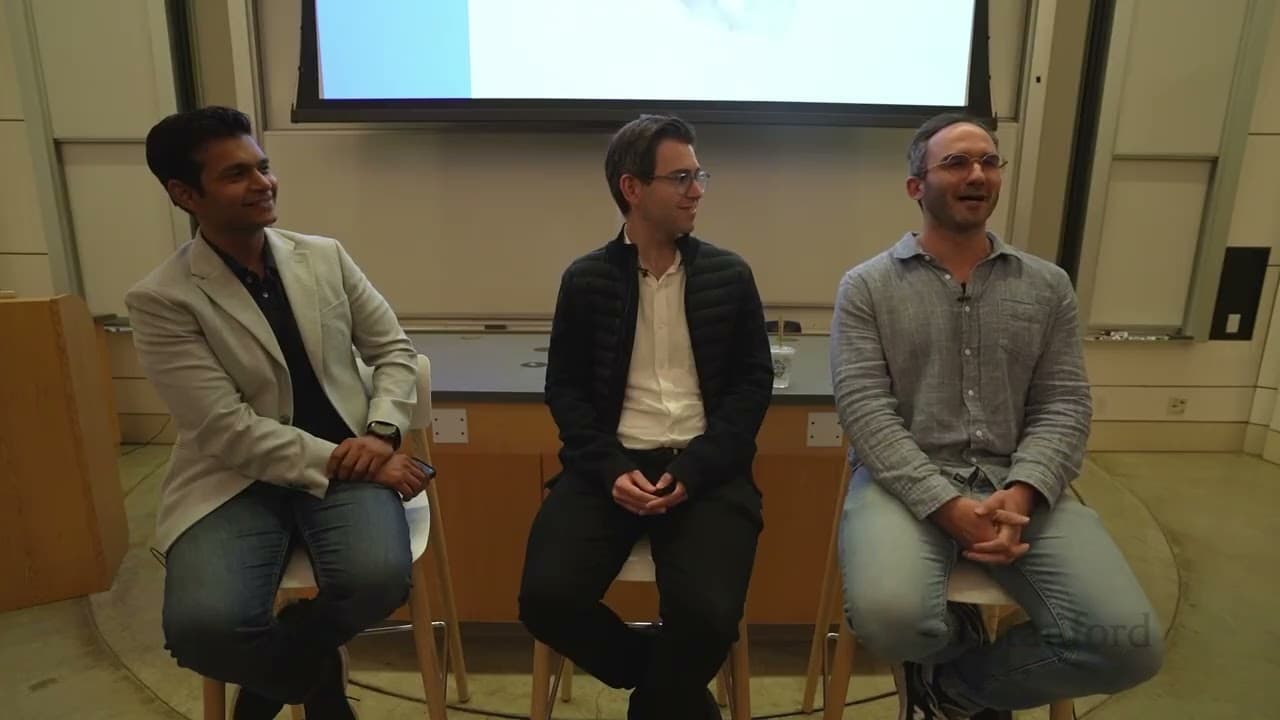
🎙 We held the ninth Lecture Club call on Stanford MS&E 435: Economics of the AI Supercycle — and honestly, I'm thrilled.
It seems this was one of the best discussions out of all nine. The secret was simple: this time I invited friends and acquaintances who really understand biotech, healthtech, and life sciences. Instead of amateur opinions (including mine), it turned into a lively debate among professionals — I will definitely try this approach again.
Lecture 9 — Eric Kauderer-Abrams (Head of Life Sciences, Anthropic). The topic was the application layer in life sciences: how AI is changing drug development and biology. We agreed on the main shift — AI in drug discovery has stopped being hype and has become a necessary foundation; but in over 20 years, not a single AI molecule has been approved, and the real bottleneck is not the model but the wet lab and scientists' distrust.
Some thoughts from the discussion:
• Nikita (me, led the call) — Invited real experts, honestly admitting that I don't understand biotech. The most striking thought wasn't about biology: you want to be not the best model, but the final solution — look for founders who solve the problem so that it ceases to exist.
• Ira (payroll for remote workers) — Drug development is driven by two forces: China and AI. You can't compete with China (simpler laws, they "work hard"), so the only chance is in AI. The molecule selection stage takes about 4 years, but with AI, it can realistically be reduced to a year.
• Alan (venture investor, own fund) — Tempered the hype: in over 20 years, not a single AI molecule has been approved, only one reached the third phase a couple of months ago. AI is now a foundation, not hype. Investors care not about the platform, but the single molecule in the clinic; the real bottleneck is the wet lab. The new frontier besides LLM is quantum annealing.
• Dasha (engineer at Nebius) — Differentiated healthtech and life science. After the Nobel for AlphaFold, everything took off, Anthropic and OpenAI have their own bio-models. Tempered the hype about "Lab in the Loop" (for now, these are agent advisors, not a robot in a test tube). Biology is just another language: nucleotides and amino acids instead of tokens, AlphaFold = transformer plus diffusion.
• Simon (MIT, AI for proteins) — The only way to make money in biology is therapeutics. The evening's counter-thesis — Eroom's law: the number of drugs per billion dollars is falling over time. But that's precisely why AI is valuable here. Advice for beginners: pay a PhD student ~$500 for personal lectures.
• Jean (futurist) — Skeptic: typical lecture, with exaggerations in numbers. Went through the "AI winters." But unlike "cold fusion," drug development time is really decreasing. And pharma is highly interconnected — "separate niche" is usually about the speaker themselves, not the industry.
• Victor (ex-Yandex) — The main architectural question: are biological tasks also "sequences" that an improved transformer with new data will handle, or is a fundamentally new architecture at the AGI level needed?
• Pasha (ex-CPO Animal Health, Mars) — Strategic bet: not on autonomous AI, but on how researchers will work together with models while their quality is below the client's required final result.
• Zoom User (no intro) — Before a complex lecture, spent 8 hours studying the topic with Claude, asking to explain everything from scratch. The main blocker in biotech is trust: specialists don't trust fast but inaccurate AI results; involving experts in working with AI will accelerate us sharply.
• Nikita (closing) — As a dilettante on Victor's side ("everything is interesting, nothing is clear"), but the analogy is reassuring: LLM in code is just a translation to Python, maybe it's the same with biology. Announcement: since there might not be a tenth lecture, we will likely explore "transformers from scratch" next.
📺 Call recording:
https://youtu.be/CcAivRr_Jql