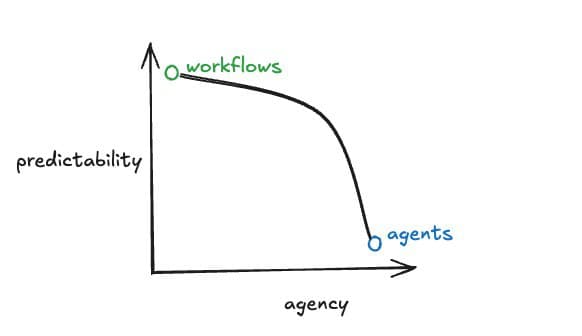
LangChain published an important text about how agentic systems are structured — and why most frameworks on the market confuse key concepts.
They criticized a recent guide from OpenAI: it offers a convenient but oversimplified abstraction of an agent, hiding the main thing — control over the context that goes into the LLM. Without it, it's impossible to build a reliable system.
LangChain offers something different: LangGraph — a framework with a clear separation of workflows and agents, a declarative API for structure, and imperative/functional API inside. Instead of black boxes — explicit nodes and connections, normal code, access to memory, and built-in support for human-in-the-loop.
The key idea: real agentic systems are not just one agent, but a mix of workflows and agents. And it is the control over the transfer of context into the LLM that makes the framework suitable for production.
🔗 Source: https://blog.langchain.dev/how-to-think-about-agent-frameworks/
🔥 Bonus (Agent Framework comparison): https://docs.google.com/spreadsheets/d/1B37VxTBuGLeTSPVWtz7UMsCdtXrqV5hCjWkbHN8tfAo/edit?gid=0#gid=0