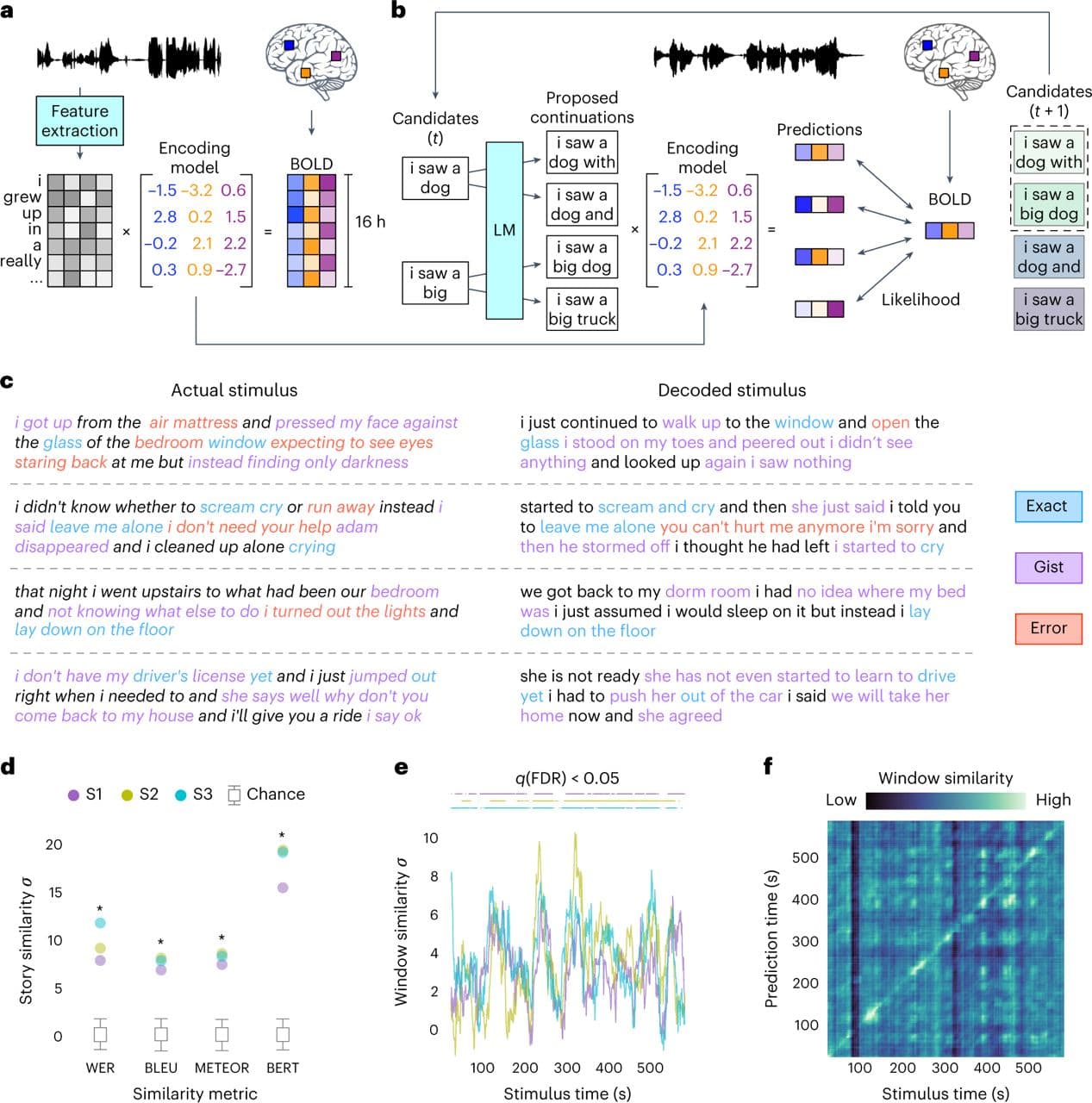
Scientists from the University of Texas at Austin have developed a system called a semantic decoder that can translate human brain activity into a continuous stream of text. This could help people who can think but cannot speak, for example, due to a stroke, to communicate clearly again.
The system is based on a transformer model similar to those used in OpenAI's ChatGPT and Google's Bard. It does not require surgical implants and does not limit users to words from a predefined list. Instead, brain activity is measured using an fMRI scanner after training the decoder, during which the person listens to hours of podcasts.
The system is not yet applicable outside the lab due to the need for fMRI, but researchers hope their work can be adapted for other, more portable systems, such as functional near-infrared spectroscopy (fNIRS).
The research was published in the journal Nature Neuroscience. The scientists take potential abuses of the technology very seriously and state that their system only works with the consent of participants, and the results are incomprehensible to untrained individuals.
Another step towards a time when you won’t need to type text slowly by pressing the screen or keys with your fingers, but simply think a thought. I’m sure this will speed up data entry by at least an order of magnitude, not to mention the number of lives saved for people who type while driving (if we are still driving by that time).