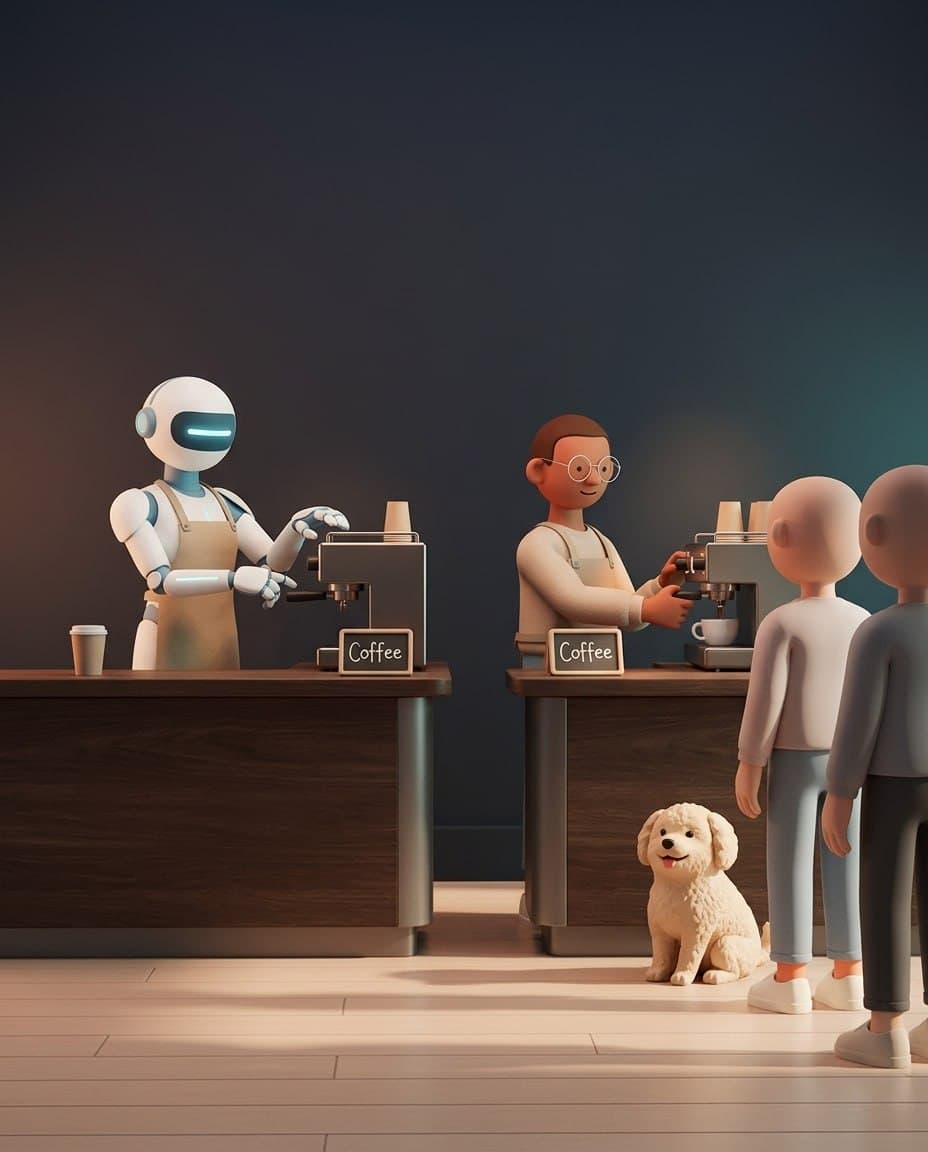
🤖 Bayram Annakov shared an insightful thought: the more automation surrounds us, the more valuable the human element becomes—and this is evident even in the numbers.
For the last couple of centuries, the share of labor in the economy has remained around 60%: through the industrial revolution, assembly lines, and computers, people have consistently received roughly the same portion of the pie in the form of wages. The question he raises is whether AI will break this constant. Machines can replicate themselves: one robot turns into many, and the usefulness of each subsequent one drops almost to zero. Meanwhile, the demand for the human touch—ballet, a live barista, handcrafted work—remains the same.
The most intriguing experiment he mentions is selling the same art print labeled "made by a human" and "made by AI." The human-made version fetches significantly more—but the premium disappears once the edition reaches 500 (the connection to "that very author" is lost). For the AI version, there is no price difference at all: it is already perceived as a commodity.
This resonates with me because the same is noticeable even now. A live performance is valued higher than a recorded one, even when it's disjointed and differs greatly from the polished studio version. There are countless lectures and knowledge available online, often for free—yet people still pay for university and travel across the world for live interactions, conversations, and the environment.
#ai@rvnikita_blog #economics@rvnikita_blog #automation@rvnikita_blog #bayram_annakov@rvnikita_blog