🚀 Tomorrow, Artemis 2 returns from its lunar flyby. The most dangerous part of the mission is ahead.
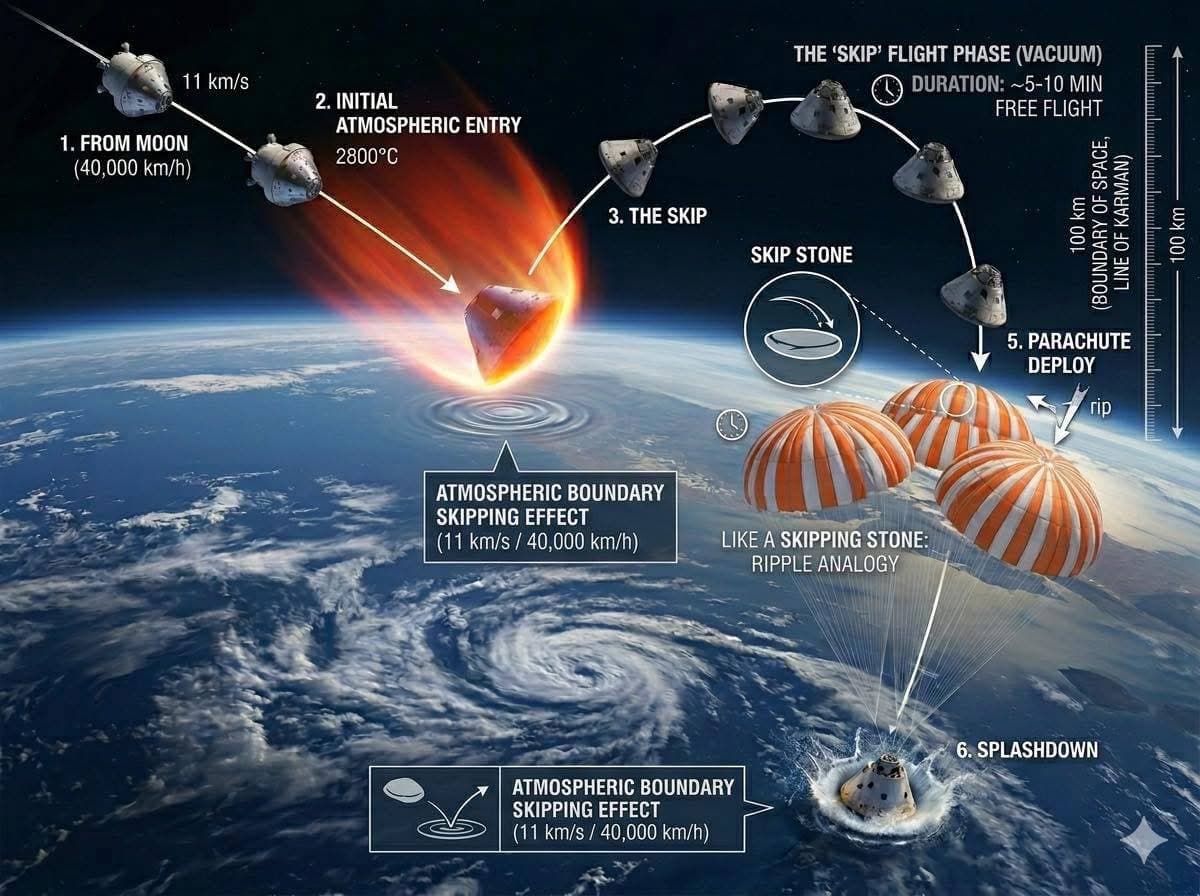
Orion is approaching Earth at a speed of 40,000 km/h. The air in front of the spacecraft heats up to 3,000 degrees - twice as hot as the surface of the Sun.
Initially, a beautiful trick was devised for Orion. The spacecraft enters the atmosphere, slows down, and bounces back up. Like a stone skipping on water. Up there, it has a couple of minutes to cool down, then a second approach and landing. Two short decelerations instead of one long drop reduce the overload from 7g to 4g.
This was tested on the uncrewed Artemis 1 in 2022. But when they retrieved the capsule from the ocean, they saw that the heat shield had cracked. More than a hundred places where pieces of the coating had come off. They figured it out: the bounce was to blame. When the spacecraft jumps out of the atmosphere, the heating drops, but the gases inside the shield continue to accumulate. There’s nowhere for the pressure to go. The shield cracks from the inside.
NASA didn’t redesign the shield. Instead, they changed the trajectory. Artemis 2 will not be skipping like a stone. Instead of a skip - a loft: the spacecraft rises slightly within the atmosphere without exiting it. Softer, without a sharp temperature drop.
For comparison. The Apollos returned from the Moon at a similar speed, but without skips - they controlled the angle of the capsule and decelerated in one go. Soyuz with the ISS approaches more easily: speed 28,000 km/h, almost one and a half times less, the atmosphere handles it without tricks.
But this new trajectory with people on board has never been flown before. Tomorrow - the first time. Landing in the Pacific Ocean near San Diego, around 3 AM Moscow time.