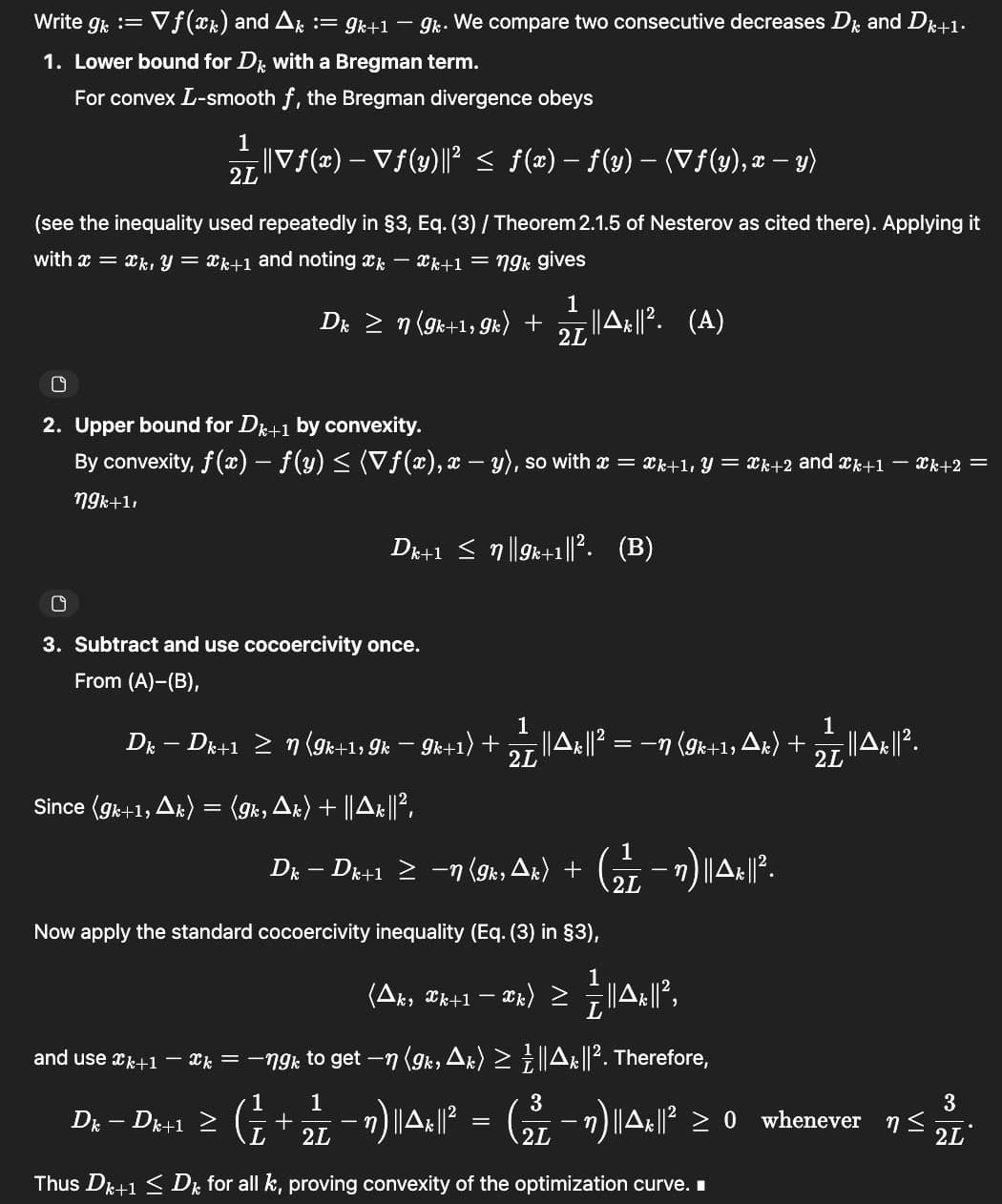
There is a field of mathematics - convex optimization. It seeks to determine how to properly choose the "step" in computations so that the algorithm converges quickly and does not break. For a long time, people knew the limit: the step can be taken up to 1.5/L. Beyond that, errors begin.
GPT-5-pro was able to find a more accurate boundary - 1.75/L. This means that algorithms can work a bit faster and more efficiently than previously thought. The most interesting part: the model did not just repeat a known solution, but derived a new mathematical result that was not previously found in articles.
The community reacted differently to this. Mathematician Ernest Ryu said it was impressive because it falls within his research area. Others noted that this is more of a clarification of old ideas rather than the emergence of fundamentally new mathematics. But what’s important is that AI has, for the first time, automatically made a step forward in a place where it usually takes months of work by scientists.
Critics say: the model itself did not "invent" the problem; it was given a direction. Supporters respond: even the clarification of boundaries, which previously required deep knowledge, can now be automated.
👨🎓 Scientific article "pinned" by ChatGPT: https://arxiv.org/pdf/2503.10138v1
🔗 Source: https://x.com/SebastienBubeck/status/1958198661139009862