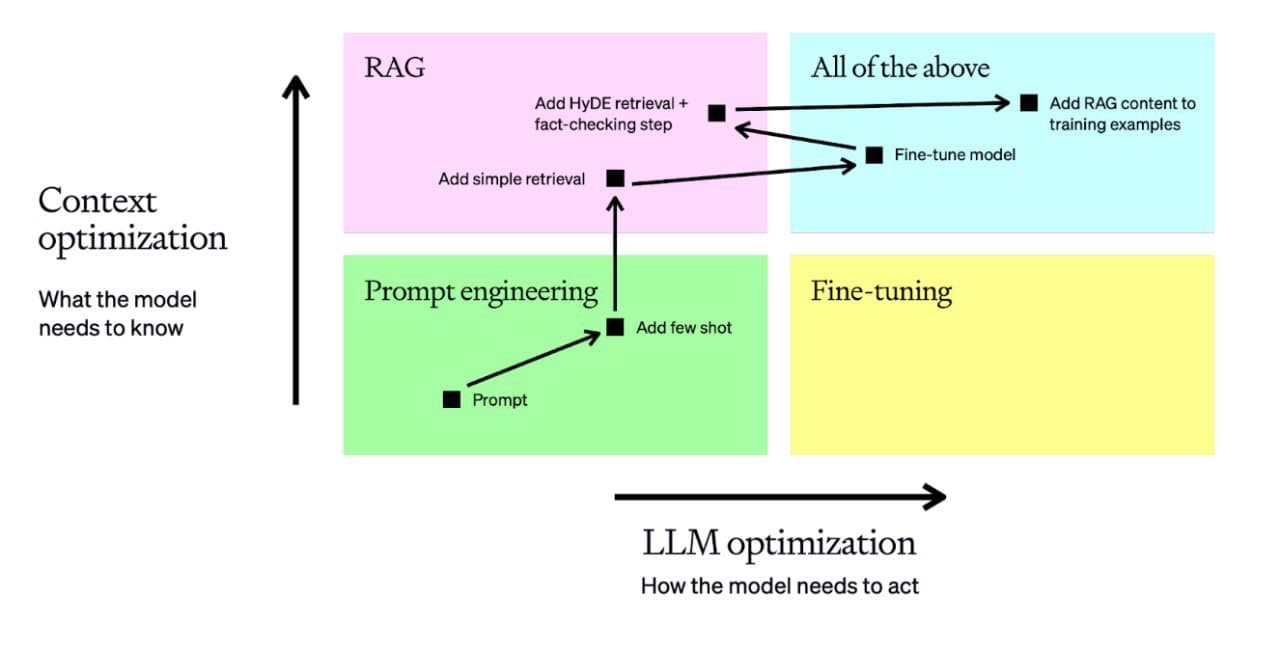
At one time, everyone rushed to finetuning, but it quickly became clear that it is expensive and complicated, requiring a quality dataset and serious resources. Finetuning is a last resort that should only be applied when necessary. This is why the step-by-step scheme from OpenAI is so valuable, allowing for excellent results by progressing from simple methods to more complex ones:
1. Prompt Engineering: the initial stage is optimizing queries. A simple prompt with clear instructions can already improve the result.
2. Few-shot prompting: adding a few examples to increase the model's stability on similar queries.
3. Retrieval-Augmented Generation (RAG): if specific knowledge is required, we add dynamic data loading into the prompt, allowing the model to work in the necessary context.
4. Fine-tuning: the final step when absolute accuracy and stability are needed. Here, a specialized dataset is created to train the model in real conditions.
I would also add the idea of multi-agent systems and the simultaneous use of models from different providers, but it’s clear that we shouldn’t expect this in OpenAI’s documentation.
📝 More details: https://platform.openai.com/docs/guides/optimizing-llm-accuracy